
Why Bookkeeping Matters for StartupsMost founders don’t start a company because they love spreadsheets. You start because you had an idea. A product. A market gap. A problem you wanted to solve. And for the first few weeks (sometimes months), finance feels simple:
So bookkeeping feels… unnecessary. Until suddenly it isn’t. Typically, this is the moment:
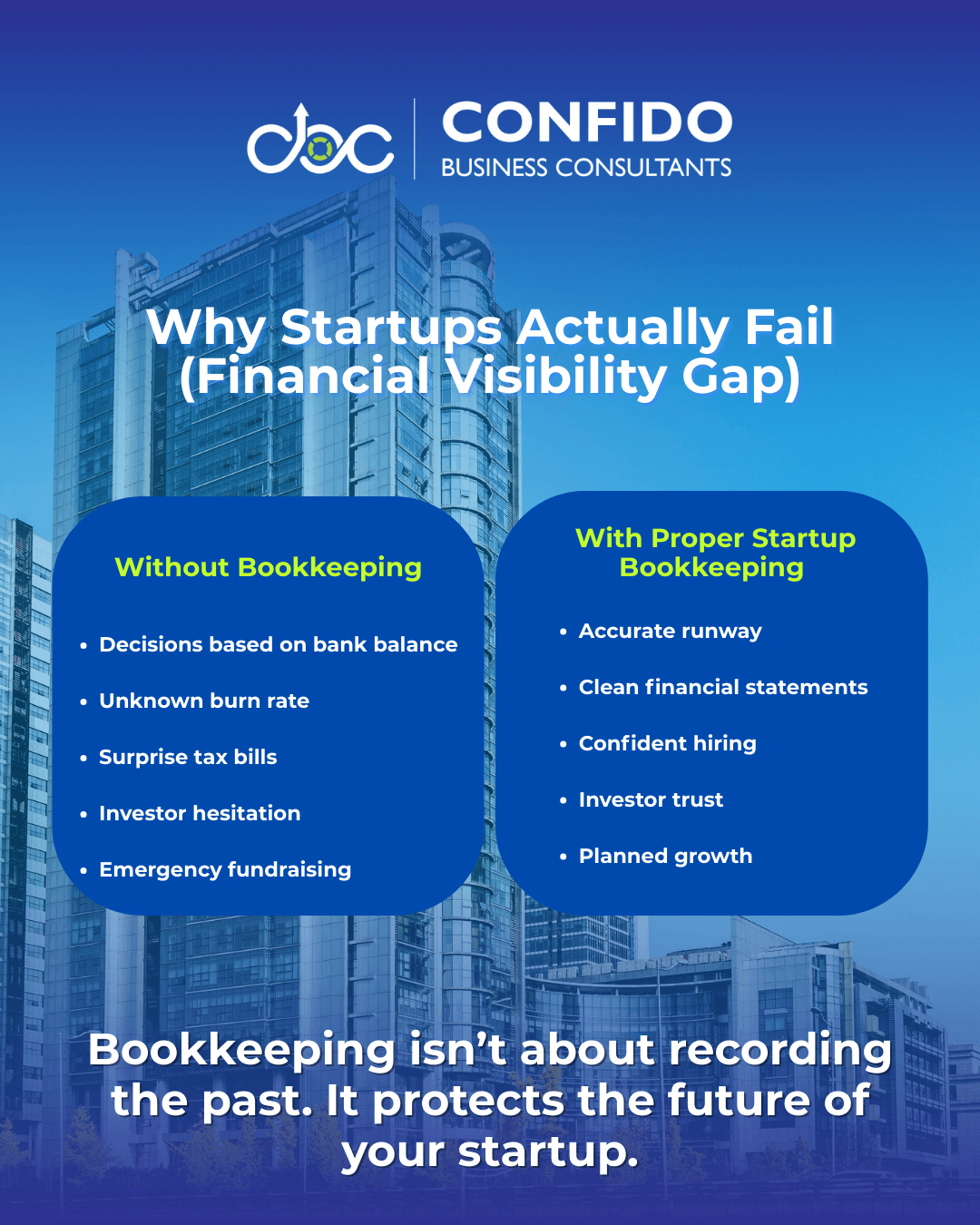
That’s when founders realise something important: Startups rarely fail because of bad products. Bookkeeping for startups is not about record-keeping. Not Just TaxesThe biggest misconception founders have: “I just need bookkeeping for tax filing.” In reality, taxes are the smallest reason a startup needs bookkeeping. A proper startup accounting system gives you:
Here’s a very common situation: A SaaS founder sees ₹8,00,000 monthly revenue and assumes profitability.
Actual profit: ₹90,000. Without bookkeeping, founders make hiring and marketing decisions based on imagined margins. This is why startup bookkeeping services are less about compliance and more about decision-making intelligence. Taxes happen once a year. Investor ExpectationsThe moment you speak to a serious investor, bookkeeping becomes non-optional. Investors don’t invest in ideas. Before even a formal due diligence process, most investors will casually ask:
Here’s the problem: Most founders think they know these numbers. They don’t. They know dashboard metrics — not financial metrics. There is a massive difference between:
Between:
Between:
A startup without proper financial reporting cannot produce:
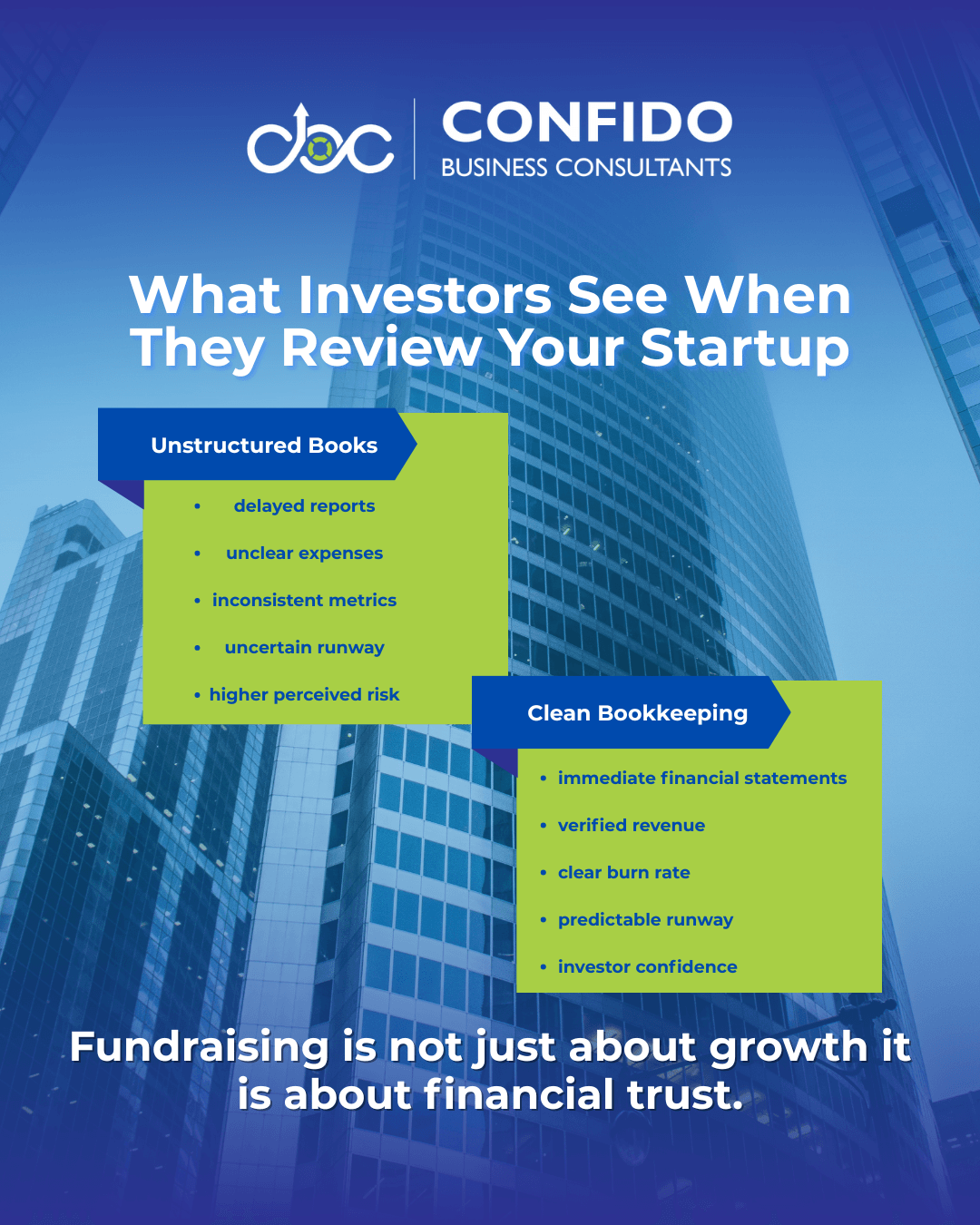
And without those, investors assume one thing: Your operations are messy. Messy finances = higher investment risk. Many early funding conversations quietly end not because the idea is weak — but because the books are unclear. Good bookkeeping doesn’t just help you report numbers. Cash Runway VisibilityEvery founder tracks revenue. Very few track cash flow correctly. This is one of the most dangerous blind spots in early-stage startups. Here’s why: Startups don’t die when revenue falls. You may have:
But salaries, software subscriptions, and vendors require real cash — not projected income. Without monthly bookkeeping services and reconciliations, you cannot calculate: Runway = Available Cash ÷ Monthly Net Burn And founders consistently miscalculate burn because they forget:
This is why many founders experience the shock month: “We thought we had 6 months. We actually had 7 weeks.” Startup bookkeeping creates one crucial leadership tool: predictability. When your books are accurate, you can:
Survival vs GrowthEarly startups operate in two modes: Survival Mode Growth Mode The difference is rarely the product. The difference is financial clarity. Without bookkeeping:
With proper accounting for startups:
Bookkeeping does something subtle but powerful: It turns a founder from a guess-based operator into a data-driven CEO. And this is exactly the stage where many startups realise: bookkeeping is no longer a task — it’s a system. | ||||||||||||||||||||||||
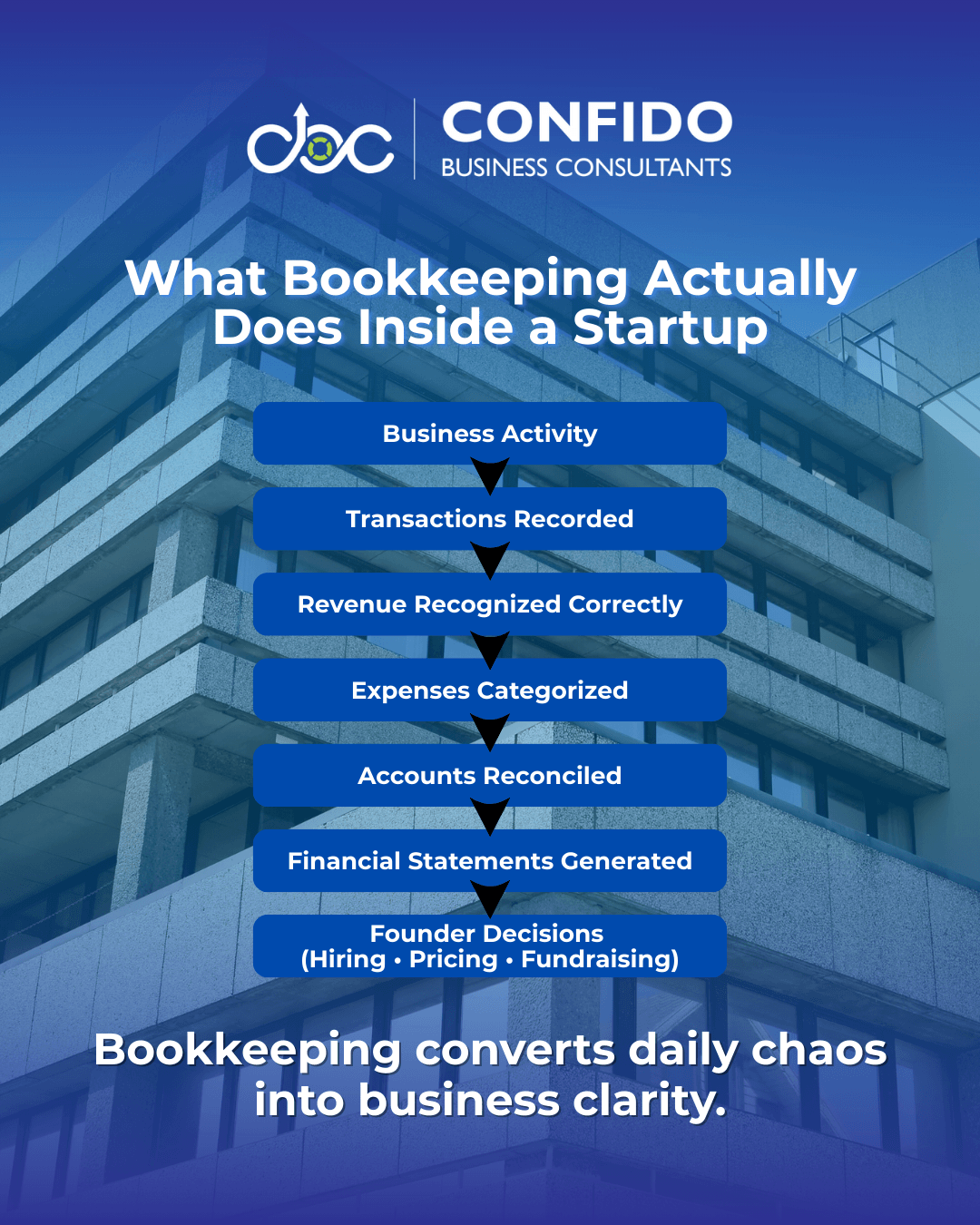
What “Bookkeeping” Actually Means (Startup Context)One reason founders delay bookkeeping is simple: They think bookkeeping means entering bills into software. That’s not bookkeeping. That’s clerical data entry. Real bookkeeping for startups is the system that turns daily business activity into reliable financial information you can actually make decisions from. Your product team tracks features. Without it, you are operating a company using memory, dashboards, and assumptions. Let’s break down what startup bookkeeping actually involves in practice. Transactions (What Actually Gets Recorded)Every movement of money in your business is a transaction. Founders usually think transactions only mean:
In reality, startup accounting tracks: Incoming
Outgoing
Non-cash transactions (very important)
This is why relying on a bank statement or Stripe dashboard is dangerous. Bank statements show cash movement. For example: You pay ₹1,20,000 annually for software. This is called accrual accounting, and it’s the foundation of investor-ready financials. Revenue Recognition (The Most Misunderstood Concept)Almost every startup gets this wrong in the beginning. Revenue is not recorded when cash arrives. Revenue is recorded when it is earned. Why does this matter? Consider a SaaS startup: Most founders record: Correct bookkeeping records: Why? Because you haven’t delivered the service yet. Recording all revenue immediately makes your startup look profitable early and unprofitable later — which completely distorts:
Investors care deeply about revenue recognition because it shows whether your financial reporting is trustworthy. Clean bookkeeping services ensure:
This single correction often changes how founders understand their business performance. Expense Tracking (Where Most Cash Actually Disappears)Startups rarely fail due to lack of revenue. They fail because expenses quietly expand. Without structured expense tracking, founders typically underestimate costs by 20–40%. Commonly missed expenses:
A founder may believe marketing costs ₹40,000/month. This directly affects:
Good startup bookkeeping categorizes expenses properly:
Once categorized, you finally see which parts of your business actually make money. Reconciliations (The Hidden Safety System)This is the most important and least understood bookkeeping function. Reconciliation means: Matching your accounting records with your real bank and payment accounts. Each month, bookkeeping compares:
Why this matters: Startups often assume software automatically records everything correctly. It doesn’t. Common issues discovered during reconciliations:
Without reconciliation, your financial statements slowly drift away from reality. This is exactly why some founders say: Because the books were never reconciled. Monthly reconciliation turns your numbers from estimates into reliable data. Financial Reports (The Actual Output of Bookkeeping)Bookkeeping is not the goal. Financial clarity is. Proper accounting for startups produces three core reports. 1. Income Statement (Profit & Loss)Shows:
This answers: 2. Balance SheetShows:
This answers: Investors and banks almost always ask for this. 3. Cash Flow StatementShows:
This answers: Many founders are surprised to learn: The cash flow statement is the report that prevents that. | ||||||||||||||||||||||||
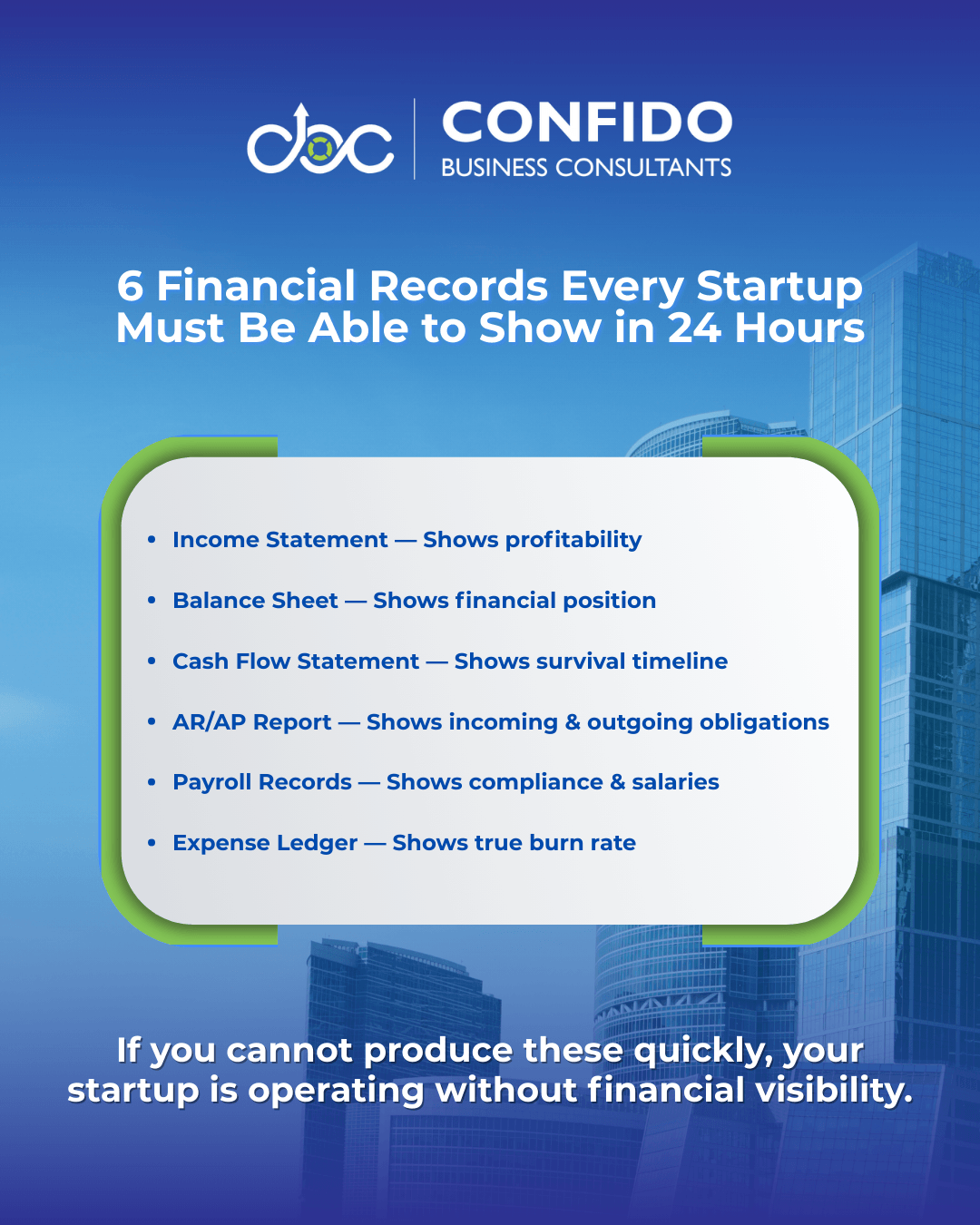
Financial Records Every Startup Must MaintainMost founders assume bookkeeping is “keeping accounts.” In reality, bookkeeping for startups is about maintaining specific financial records that allow a business to function legally, operationally, and investably. A startup doesn’t get into trouble because numbers weren’t calculated. When a tax authority, bank, acquirer, or investor asks for records, they are not asking for your memory or screenshots. They want structured documentation. Below are the core financial records every startup should be able to produce at any time — ideally within 24 hours. 1. Income Statement (Profit & Loss Statement)This is the first report anyone serious about your company will request. The income statement shows:
It answers a very simple but critical question: Is your business model working? For founders, this report is often eye-opening. A startup might feel profitable because revenue is growing, but the income statement may reveal:
This is also the report investors use to understand your unit economics. Without a clean income statement, conversations about valuation become guesswork. 2. Balance SheetMany early-stage founders ignore the balance sheet. Investors never do. The balance sheet shows the financial position of your company on a specific date. It includes: Assets
Liabilities
Equity
Here is why this matters: You might think your company has ₹10,00,000 because your bank account shows it. But your balance sheet may reveal:
Actual usable cash: far lower than expected. The balance sheet prevents founders from spending money they don’t actually have. It is also mandatory during due diligence. 3. Cash Flow StatementThis is the most practical report for founders — and the least commonly maintained in early startups. Revenue does not keep your company alive. Cash does. The cash flow statement tracks:
It helps you calculate: Burn Rate Runway A startup can show profit in the income statement and still collapse due to cash shortages. This happens when:
Regular bookkeeping services generate a monthly cash flow statement so founders can plan hiring, marketing, and fundraising calmly — not reactively. 4. Accounts Receivable & Accounts Payable (AR/AP)Startups often manage invoices through email and memory. That works — until volume increases. Accounts Receivable (AR) tracks:
It answers: Accounts Payable (AP) tracks:
It answers: Why this matters: Many startups face a hidden cash crunch because:
Without AR/AP tracking, founders discover shortages only when payments bounce. Proper startup accounting allows you to:
Cash flow problems often originate here — not from low revenue. 5. Payroll RecordsHiring employees changes the financial complexity of your startup overnight. Payroll is not just salary payments. It includes:
Improper payroll documentation creates serious risk:
Investors routinely ask whether payroll taxes are compliant before investing. Why? Because unresolved payroll liabilities can legally follow the company. Accurate payroll records also ensure:
For many founders, this is the point they first realize DIY bookkeeping is becoming risky. 6. Expense TrackingThis is where financial leakage usually occurs. Startups spend money in small, scattered amounts:
Individually minor. Without systematic expense tracking:
Good bookkeeping services categorize expenses into clear groups:
Once tracked properly, founders can answer important questions:
This is often the moment when startups shift from reactive spending to intentional budgeting. | ||||||||||||||||||||||||
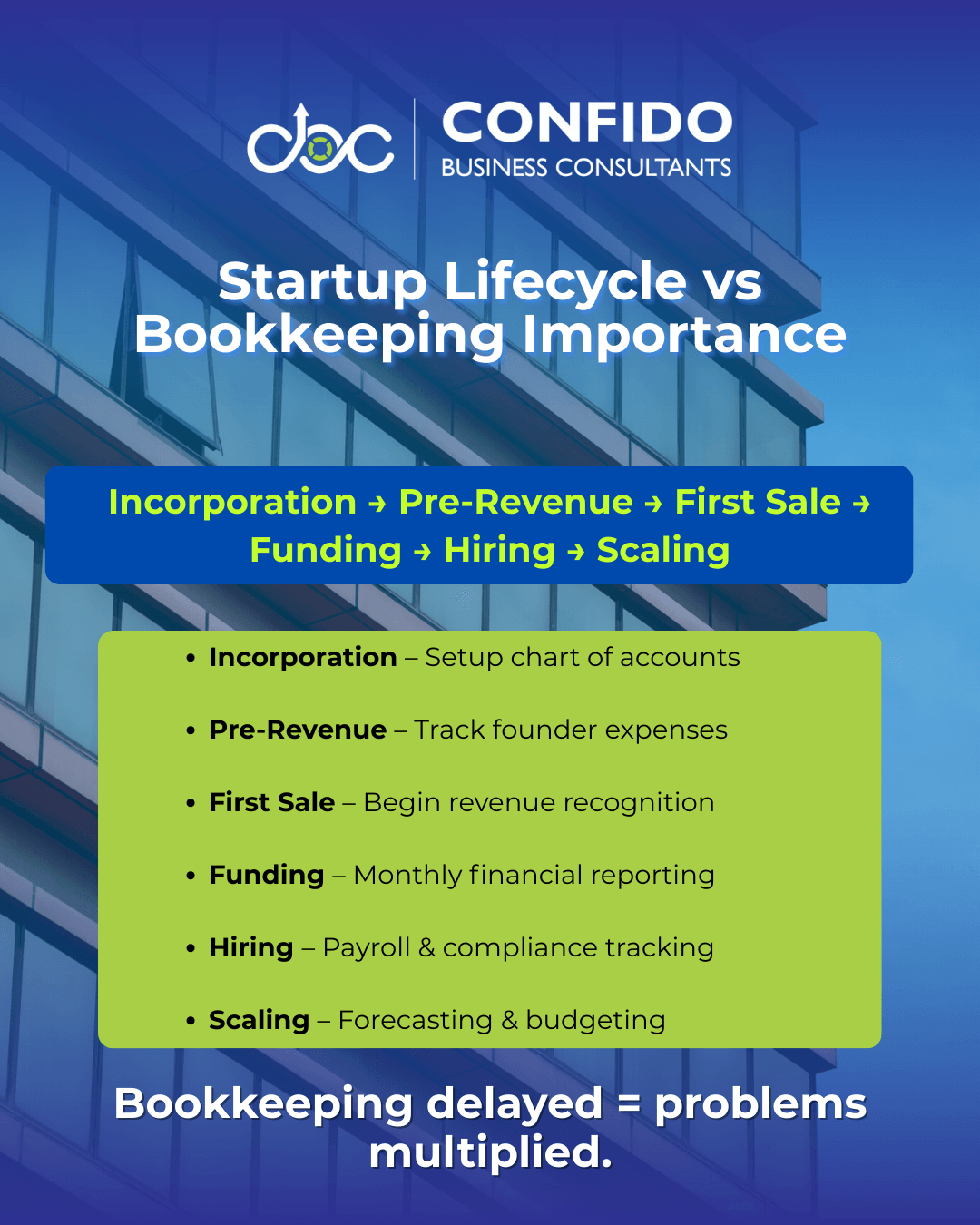
When Startups Should Start BookkeepingOne of the most common founder questions is: “At what stage do we actually need bookkeeping?” Most founders believe bookkeeping begins when:
In reality, startups don’t face problems because bookkeeping started too early. The difficult part is this: You only realize you needed bookkeeping months after the moment you actually needed it. Let’s look at the four typical startup stages and what bookkeeping means in each. Pre-Revenue Stage (Yes — Even Before You Earn)This is the stage many founders skip. You’re building the product. No customers yet. No invoices. Just expenses. So it feels unnecessary to set up accounting for startups. But financially, important things are already happening:
If these are not recorded properly from day one:
Later, when the startup grows, founders often struggle to answer a basic question: “How much money have we actually put into this company?” Early bookkeeping also helps with:
The best time to create a financial system is when transaction volume is low — not when it becomes chaotic. First Sale (The Real Beginning of Bookkeeping)Your first customer changes everything. The moment revenue begins, your startup becomes:
From this point, bookkeeping for startups is no longer optional. Why? Because now you must track:
Many founders rely on payment dashboards (Stripe, Razorpay, PayPal). They do not:
If bookkeeping does not begin at the first sale, you create a backlog that becomes extremely expensive to clean later — often called “catch-up bookkeeping.” And clean-up bookkeeping is significantly more time-consuming and costly than starting correctly. After Funding (The Stage Where Bookkeeping Becomes Critical)This is the stage where startups most often panic about finances. The moment external money enters your company — angel investment, seed funding, grants — expectations change immediately. Investors now expect:
Your books now serve more than internal purposes. Investors do not monitor your effort. Poor financial reporting after funding creates:
Even simple questions become stressful:
Structured startup bookkeeping converts these into straightforward answers. Without it, founders spend days preparing numbers before every investor conversation. With it, reports already exist. Hiring Employees (The Point Risk Increases Rapidly)The first hire is a major operational milestone. It is also a major financial compliance shift. Payroll introduces:
Incorrect payroll handling creates real legal exposure — not just accounting inconvenience. Common early mistakes:
This is usually the stage when founders realise DIY bookkeeping systems (especially spreadsheets) stop working. Why? Because bookkeeping is no longer about tracking money. Monthly bookkeeping services at this point prevent:
The Real AnswerSo when should a startup start bookkeeping? Not at profit. At incorporation — and definitely no later than the first financial transaction. Startups that begin early:
Startups that delay bookkeeping usually face the same situation later: | ||||||||||||||||||||||||
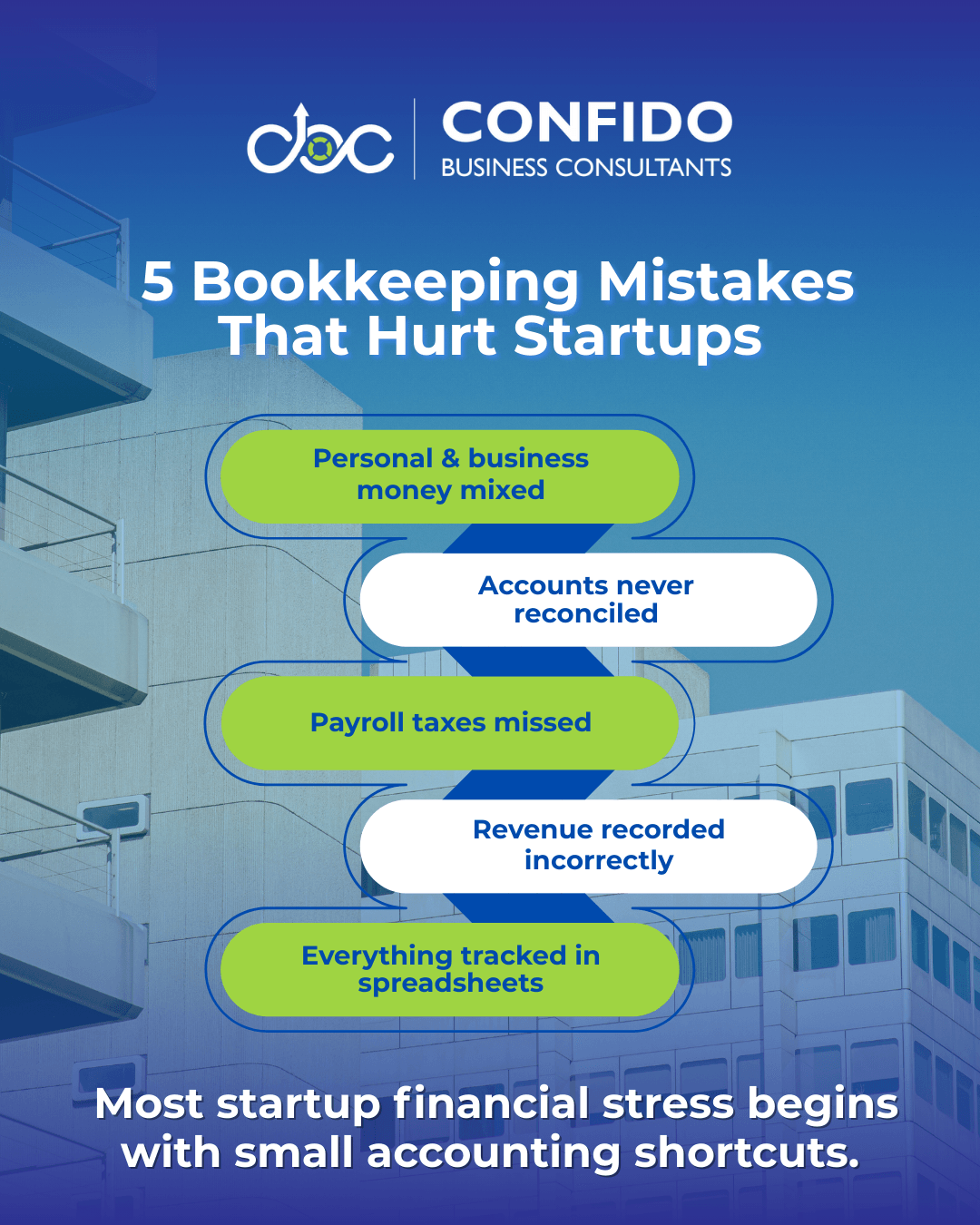
Common Startup Bookkeeping MistakesFounders don’t ignore bookkeeping because they don’t care about finance. They ignore it because, early on, the company feels small enough to manage mentally. And for a short time, that works. Then growth begins — more customers, more subscriptions, more payments, more vendors — and the system that worked for 12 transactions a month starts collapsing under 200. Below are the most frequent bookkeeping mistakes seen in early-stage startups. Mixing Personal & Business FinancesThis is the first and most damaging error. In the early stage, founders often:
It feels harmless because “it’s still my company.” But financially, this creates three problems:
Investors and acquirers specifically check this. Why? Because mixed finances suggest weak operational discipline. A clean startup accounting system separates:
Without that separation, your profit numbers are simply not credible. Not Reconciling AccountsMany startups record transactions but never reconcile them. Meaning: So founders believe they have bookkeeping — but they actually have a recording system, not a verification system. This leads to:
The result is familiar: “QuickBooks shows profit, but our bank account is empty.” Monthly reconciliations are what make financial reports trustworthy. Ignoring Payroll TaxesThis mistake usually happens after the first few hires. A founder hires an employee and thinks: But payroll includes:
The risk here is serious. Unlike many compliance issues, payroll liabilities can become personal liability for directors in certain jurisdictions. Investors are extremely cautious about startups with payroll issues because:
Proper bookkeeping services ensure payroll entries, filings, and reports align with actual salary payments. Wrong Revenue RecognitionThis one is subtle and very common in SaaS and service startups. Founders record revenue when they receive payment. But accounting for startups requires revenue to be recorded when it is earned. Examples:
Recording full revenue immediately artificially inflates profit in early months and depresses it later. This distorts:
When investors adjust your numbers during diligence, credibility suffers — even if the mistake was unintentional. Correct revenue recognition is one of the clearest signals that a startup understands financial reporting. DIY SpreadsheetsAlmost every startup begins with Excel or Google Sheets. And initially, spreadsheets feel efficient:
The problem is scale and accuracy. Spreadsheets:
As transaction volume grows, founders spend increasing time fixing the sheet instead of running the company. At this stage, bookkeeping stops being a minor admin task and becomes a weekly operational burden. This is typically the point founders realize: the cost of doing bookkeeping yourself becomes higher than outsourcing it. | ||||||||||||||||||||||||
Best Accounting Software for StartupsOnce founders realise spreadsheets aren’t sustainable, the next question is: “Which accounting software should we use?” Software does not replace bookkeeping — but the right software makes bookkeeping efficient, accurate, and scalable. The goal is not just recording transactions. QuickBooks OnlineThis is the most widely used startup accounting platform globally. Why startups prefer it:
It generates:
Most outsourced bookkeeping services use QuickBooks because it standardizes reporting and simplifies audits. For many startups, QuickBooks becomes the foundation of monthly financial reporting. XeroXero is another strong bookkeeping software for startups, particularly popular among tech-savvy founders. Key advantages:
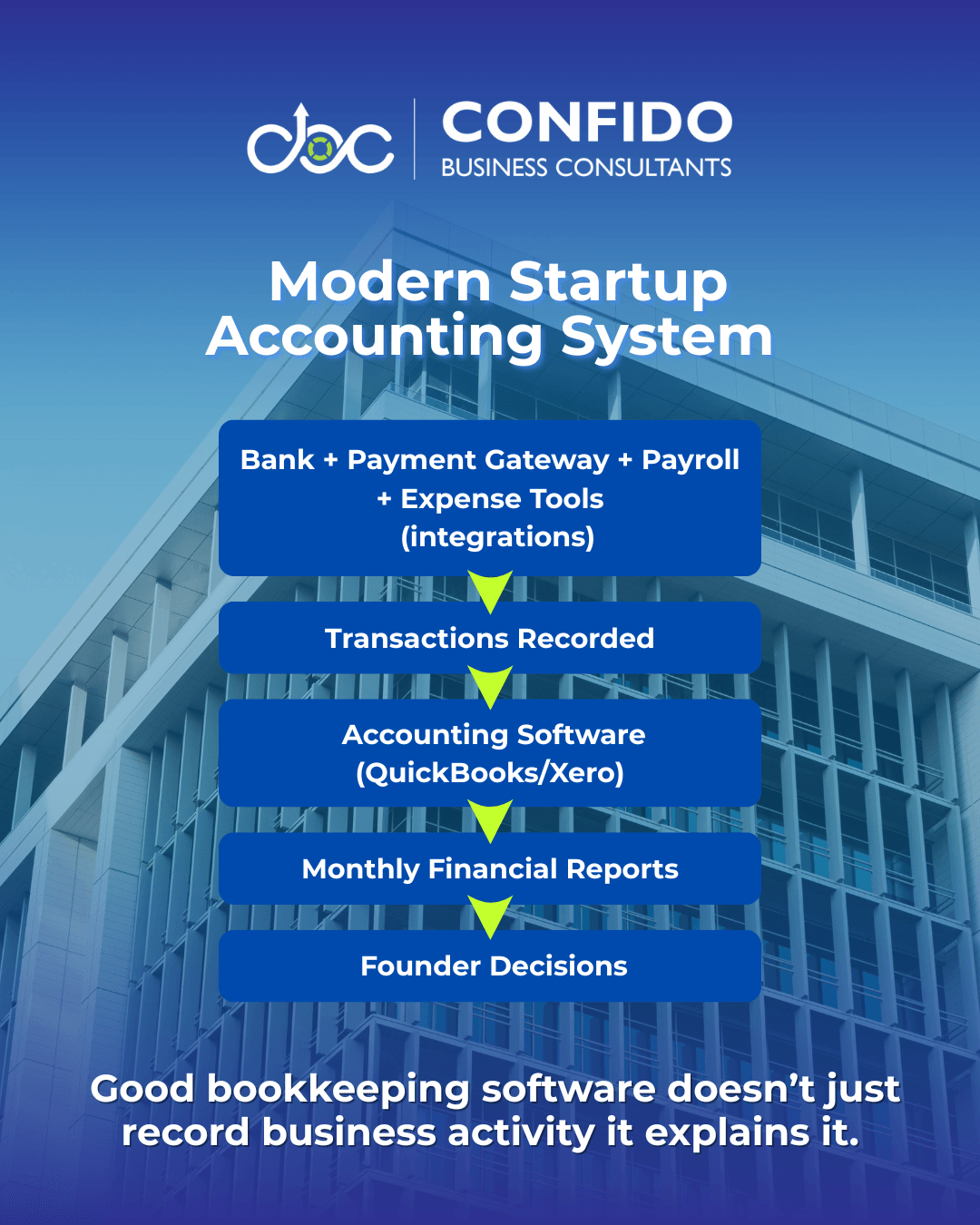
Many SaaS and internationally operating startups prefer Xero because it handles global transactions smoothly. Both QuickBooks and Xero are reliable — the better choice usually depends on your integrations and reporting needs. Integrations (Why Software Actually Matters)The real power of accounting software comes from integration. Modern startup accounting systems connect with:
Instead of manual entry, transactions flow automatically into your books. This reduces:
Bank FeedsBank feeds automatically import transactions from your bank account daily. This means:
Without bank feeds, bookkeeping becomes reactive. AutomationAutomation is the real benefit startups gain. Good bookkeeping software can:
Instead of preparing reports at year-end, you get monthly visibility. And monthly visibility changes founder behavior — decisions become data-driven rather than instinct-driven. | ||||||||||||||||||||||||
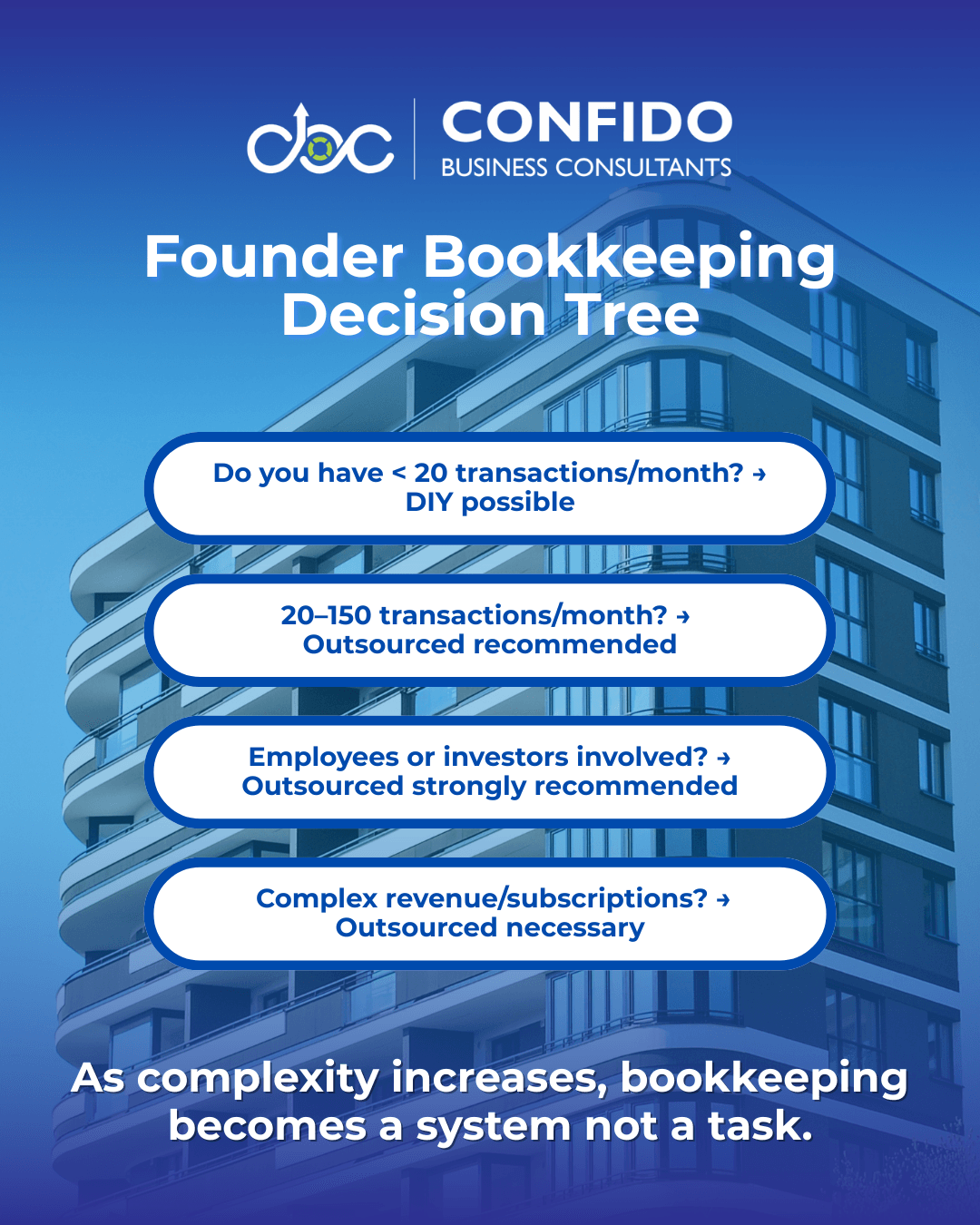
DIY vs Hiring a Bookkeeper vs OutsourcingAt some point, every founder reaches this moment: “Should I keep managing the books myself, hire someone internally, or outsource it?” This is not just a financial decision. Because bookkeeping for startups is not measured only by the money it costs — but by the mistakes it prevents and the time it frees. Let’s look at the three options realistically. Option 1: DIY Bookkeeping (Founder Does It)This is how most startups begin. The founder:
Initially, it seems efficient and cost-saving. But here’s what actually happens over time: Bookkeeping doesn’t happen daily. The hidden cost is context switching. Every hour a founder spends:
…is an hour not spent on product, hiring, or sales. The real cost of DIY bookkeeping is not accounting errors. It is founder distraction. Startups rarely fail because founders delegated too early. Option 2: Hiring an In-House BookkeeperThis feels like the natural next step. You hire an employee to:
Advantages:
But early-stage startups often underestimate the true cost. Beyond salary, you also incur:
An in-house bookkeeper can handle routine recording, but complex areas — revenue recognition, compliance, financial reporting — often still require external expertise. So many startups end up paying: Option 3: Outsourced Bookkeeping ServicesThis is where many growing startups eventually land. Instead of hiring a person, you hire a financial system — a team with processes, checks, and reporting structures. Outsourced bookkeeping typically includes:
The biggest difference is not just cost — it is reliability. A team structure means:
Cost Comparison
For most early-stage companies, outsourced bookkeeping services become economical sooner than expected — especially when founder time is valued realistically. Risk Comparison
Bookkeeping errors don’t appear immediately.
And that’s when correction becomes expensive. Time CostFounders often underestimate this part. Monthly bookkeeping requires:
Even at small scale, this becomes 6–10 hours/month. Outsourcing converts that recurring mental load into a background system. You still see reports. Compliance RiskThis is the most important factor. Incorrect bookkeeping affects:
Compliance mistakes usually don’t show warnings. And by the time a notice arrives, correction is reactive instead of preventive. This is why many founders switch not because bookkeeping is difficult — but because compliance risk becomes uncomfortable. Key takeaway: | ||||||||||||||||||||||||
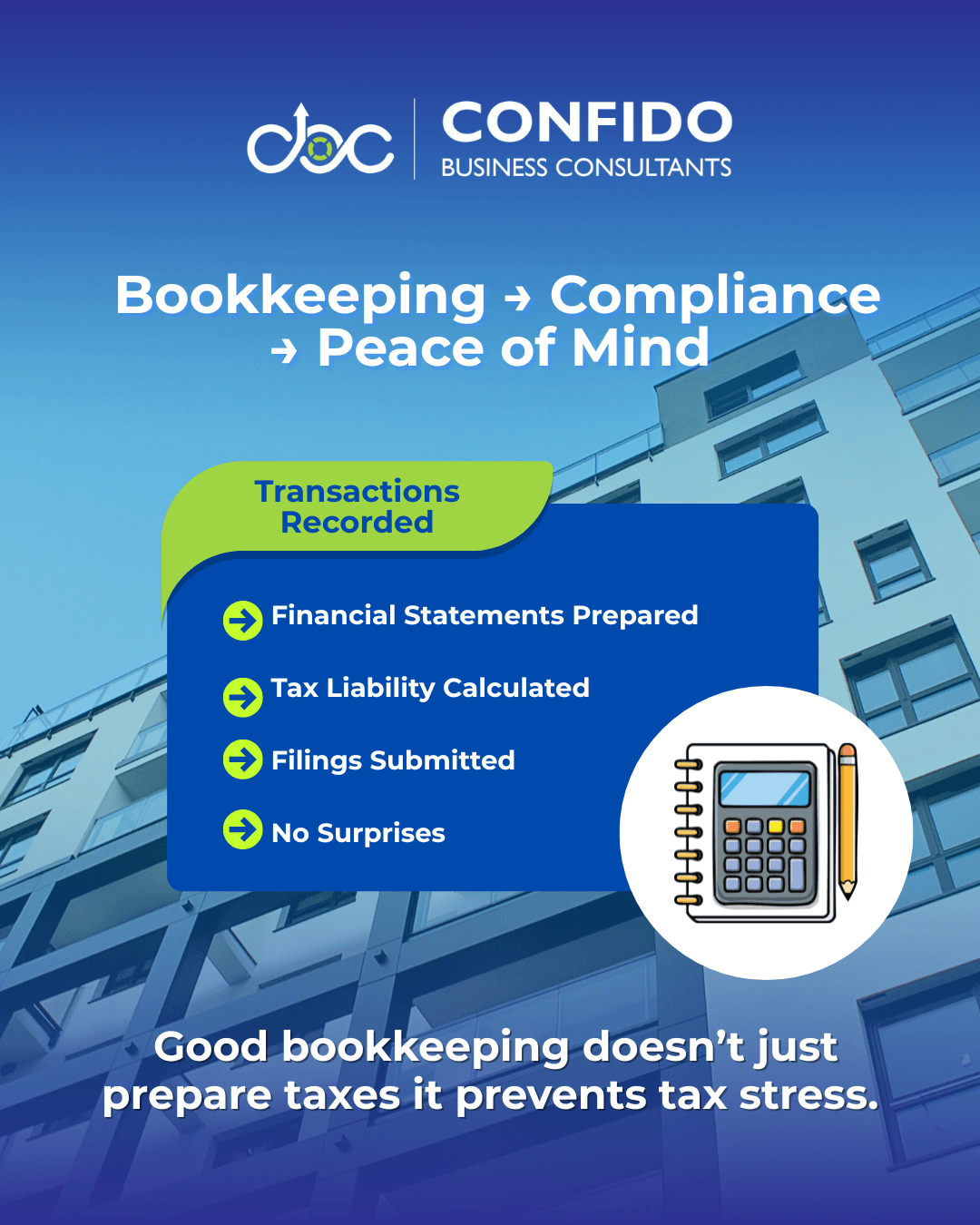
How Bookkeeping Affects Taxes & ComplianceMost founders first think about bookkeeping during tax season. Ironically, taxes become stressful primarily when bookkeeping hasn’t been maintained regularly. Taxes are not calculated from bank statements. Proper startup accounting ensures that compliance becomes routine instead of urgent. Income Taxes (IRS / Corporate Tax Reporting)Your tax return is based on:
If bookkeeping is incomplete:
Or worse: Clean books make tax filing straightforward. The difference is preparation throughout the year. Sales TaxStartups selling digital products, services, or goods often unknowingly cross tax thresholds. Sales tax rules depend on:
Without organized bookkeeping:
Founders often discover this months later when liabilities have already grown. Proper bookkeeping tracks taxable vs non-taxable revenue automatically. Payroll TaxOnce employees are hired, payroll taxes become recurring compliance. Payroll involves:
Even a small delay can create penalties. Bookkeeping aligns payroll payments with payroll filings — preventing discrepancies between what was paid and what was reported. 1099s and Contractor ReportingMany startups work with freelancers, consultants, and contractors. At year-end, businesses must report contractor payments above certain thresholds. Without organized accounting:
Proper bookkeeping categorizes contractor payments during the year, so reporting is automatic instead of rushed. Why This MattersCompliance rarely feels urgent — until a deadline or notice appears. Consistent bookkeeping changes compliance from a once-a-year event into a monthly routine. Instead of preparing for taxes in March, you are ready in January. And founders experience an underrated benefit: predictability. You know approximately what taxes will be — months before filing. | ||||||||||||||||||||||||
Bookkeeping for Fundraising & InvestorsMany founders believe fundraising is about pitch decks. Investors know it is about numbers. A good story gets you a meeting. The moment you begin speaking to angels, VCs, or even serious strategic partners, your startup moves from “idea evaluation” to operational evaluation. And the first thing evaluated is not your codebase. It’s your financial discipline. This is where bookkeeping for startups becomes extremely visible — because investors don’t just look at your growth, they look at how well you understand your own business. Due Diligence (Where Most Surprises Happen)After initial interest, investors begin a process called due diligence. This is not an interrogation. They want to verify:
And almost all of it comes from your accounting records. Typical documents requested:
Here is where many founders get stuck. Not because the business is weak — but because the numbers cannot be compiled quickly. When books are unstructured, founders spend weeks:
This delays funding. Sometimes it quietly ends it. Investors interpret slow or inconsistent financial reporting as operational risk. Clean startup bookkeeping sends the opposite signal: This team understands execution. Financial Statements (Your Startup’s Credibility Document)During fundraising, three reports matter more than your slide deck:
Investors rarely rely on dashboard metrics alone. For example:
If dashboard metrics and financial reports don’t align, investors question forecasting accuracy. Financial statements serve one purpose in fundraising: credibility. They show:
A founder who knows their numbers precisely appears more investable than one who knows only high-level metrics. Burn Rate (The Number Investors Watch Closely)Burn rate is not simply how much money you spend monthly. It is how fast your startup is consuming cash after operating income. Without accurate bookkeeping, burn is often miscalculated because founders miss:
An underestimated burn rate creates serious fundraising problems. If you tell an investor you have 8 months of runway but financial records show 4, trust erodes immediately. Accurate monthly bookkeeping services produce a reliable burn calculation: Net Burn = Monthly Cash Outflow − Monthly Cash Inflow This single number shapes:
Runway Calculation (Your Survival Timeline)Runway is the question behind every investor’s mind: How long can this company operate without new funding? Runway depends entirely on bookkeeping accuracy. Runway = Available Cash ÷ Net Monthly Burn Without reconciled accounts and categorized expenses, founders typically overestimate runway. Why? Because pending liabilities aren’t included:
When books are clean, runway becomes predictable. Predictability changes fundraising behavior. Instead of raising capital urgently, founders raise capital strategically — from a position of strength. Investors strongly prefer startups that raise early rather than late, because it signals financial awareness. What Investors Actually Look ForContrary to popular belief, investors are not expecting perfect numbers. They are looking for:
Messy finances suggest future operational surprises. Clean books suggest reliability. In many early-stage deals, bookkeeping quality influences investor confidence as much as traction. | ||||||||||||||||||||||||
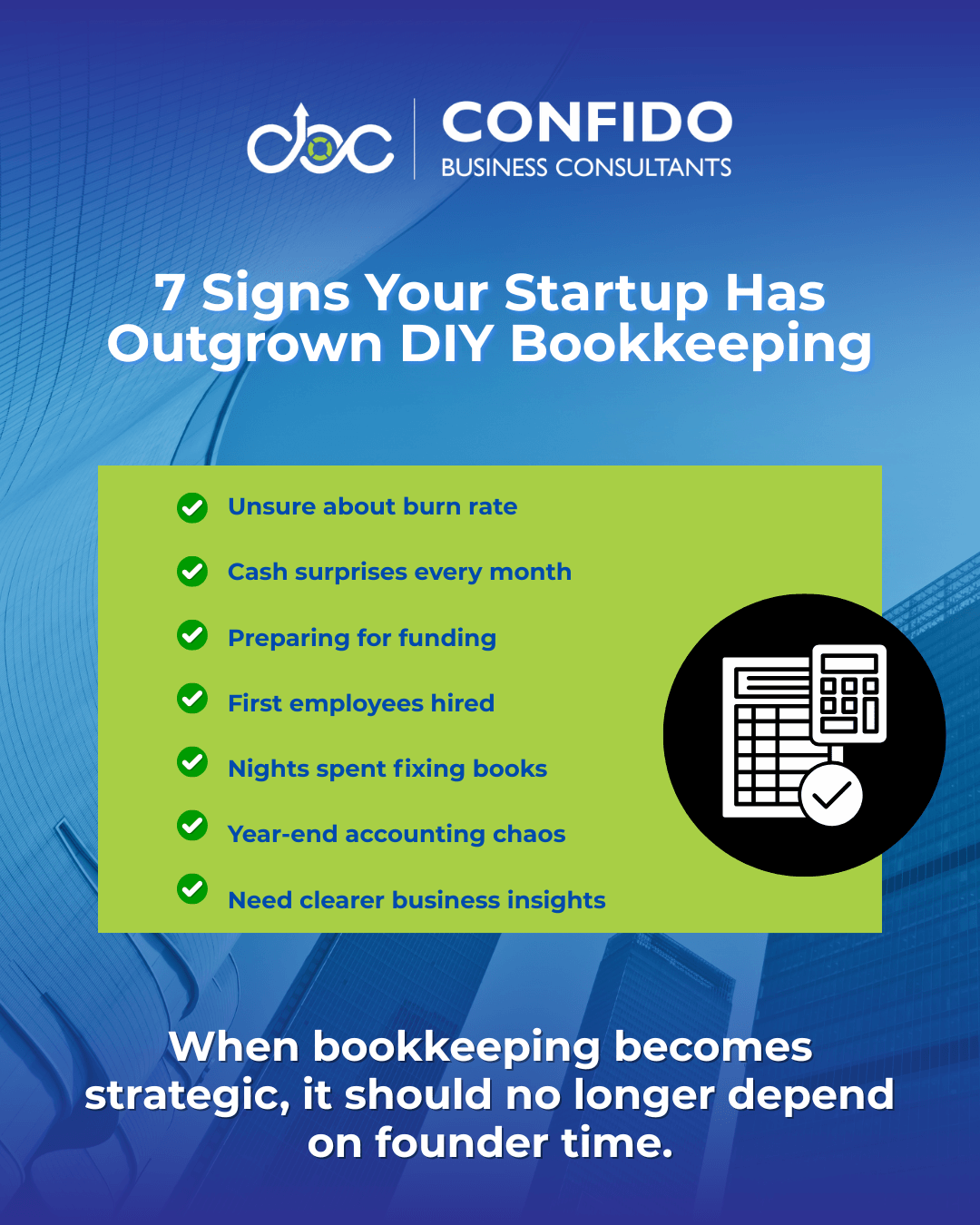
When a Startup Should Outsource BookkeepingFounders rarely wake up one morning and decide: “Today we will outsource bookkeeping.” The decision usually comes after a pattern of small financial friction:
Bookkeeping becomes visible not when the company grows large — but when complexity grows faster than attention. Below are the most reliable signals that your startup has crossed the point where DIY systems are no longer safe or efficient. You Don’t Fully Trust Your NumbersIf you have ever hesitated before answering:
…you are already operating without financial visibility. Many founders track dashboards but not financial statements. Dashboards show activity. When founders stop trusting their own reports, decision-making slows. Hiring pauses. Spending becomes cautious or reckless — but rarely confident. Accurate monthly bookkeeping services restore one essential leadership asset: certainty. Bank Balance ≠ What You Think You HaveA classic startup moment: The bank account shows money. This happens because:
are not visible without reconciled books. If your cash position regularly surprises you, your business is not lacking revenue — it is lacking structured accounting. You’re Preparing for Funding (or Want to Soon)This is one of the clearest triggers. If you plan to:
you will be asked for financial records. Not summaries. Outsourced bookkeeping services ensure:
Founders who organize finances before fundraising negotiate calmly. You’ve Started HiringHiring increases operational complexity instantly. Now your company has:
Mistakes here don’t remain internal. The first employee is often when startups realize bookkeeping is no longer administrative — it is regulatory. Outsourcing reduces risk because payroll and reporting align automatically with accounting records. You Spend Evenings Fixing BooksA subtle but important signal: You are working on bookkeeping at night or weekends. That is not just a time issue. When founders personally maintain records, bookkeeping becomes periodic and reactive. Financial reporting works best when it is:
Outsourcing converts bookkeeping from a task you remember into a system that runs continuously. You still review reports. Your Accountant Only Appears During Tax SeasonMany startups operate like this: The accountant contacts them once a year. This model works for very small businesses. Startups need ongoing financial reporting, not annual correction. Bookkeeping supports accounting. If your tax preparer spends most of their time asking for missing records, the issue is upstream — not at tax filing. Your Books Need “Cleanup”If you have heard phrases like:
you are already in delayed accounting mode. Cleanup bookkeeping is always more expensive and stressful than maintaining monthly books. Outsourcing early prevents backlog accumulation — which is what usually forces emergency corrections before funding or tax filing. You Want to Understand the Business — Not Just Run ItThere is a turning point in every startup. Initially, the goal is to launch and survive. Later, the goal becomes optimization:
These questions cannot be answered through intuition alone. They require structured financial reporting. This is when founders stop asking: …and start asking: “Should I still be doing this myself?” The Real Reason Founders OutsourceIt is not because bookkeeping is hard. It is because bookkeeping becomes important. At early scale, bookkeeping records history. Outsourcing is less about delegation and more about installing a financial operating system inside the company. | ||||||||||||||||||||||||
Conclusion + CTAIn the early days of a startup, bookkeeping feels optional. You’re focused on building, shipping, talking to customers, fixing bugs, closing your first deal. But here’s what most founders eventually discover: Things don’t settle down. More customers → more transactions And without structured bookkeeping, every milestone becomes harder than it should be. What This Guide Really MeansBookkeeping for startups is not about satisfying accountants. It is about giving founders three critical advantages: Clarity Confidence Credibility Most founders think bookkeeping is backward-looking — recording the past. In reality, it is forward-looking. The Shift Most Founders ExperienceAt first, founders ask: “Do we really need bookkeeping yet?” Later, they ask: “How were we operating without it?” Because once monthly financial reports exist:
The business doesn’t just feel active — it feels under control. Where Many Startups StruggleThe challenge isn’t awareness. It’s timing. Most startups try to set up bookkeeping:
That’s when it feels overwhelming — because records must be reconstructed instead of maintained. Starting earlier makes everything simpler:
A Practical Way to Think About ItYou don’t install analytics after scaling marketing. Similarly: You don’t install financial systems after financial stress. You install them so the stress never happens. Final ThoughtYour startup already tracks product metrics, marketing metrics, and user metrics. Financial metrics deserve the same consistency. Because at the end of the day: Products attract users. If you want to understand whether your current financial setup actually reflects your business reality, the easiest first step is a simple review of how your books are structured today. Many founders don’t need an immediate overhaul — they just need clarity on what’s missing and what can be improved. You can explore how structured bookkeeping and financial reporting typically work for growing startups here: Or, if you prefer, start by reviewing your current reports — income statement, balance sheet, and cash flow — and ask a simple question: “Do these numbers help me make decisions, or just record activity?” If the answer is the second, it may be time to move from managing accounts to managing a business. | ||||||||||||||||||||||||
Frequently Asked Questions (FAQs)Do startups need bookkeeping before revenue?Yes. Bookkeeping should ideally begin as soon as the company starts incurring expenses — not when revenue starts. Even in the pre-revenue stage, startups purchase domains, software tools, laptops, and pay contractors. Recording these properly helps track founder investment, claim valid deductions later, and present a clean financial history to future investors. Waiting until revenue begins usually creates missing records that must be reconstructed later. Can I use Excel instead of accounting software?Spreadsheets can work temporarily when transactions are extremely limited. But Excel is not an accounting system. It does not automatically reconcile bank accounts, track audit history, categorize transactions reliably, or generate structured financial statements. As transaction volume grows, spreadsheets become error-prone and time-consuming. Most startups eventually move to bookkeeping software for startups like QuickBooks or Xero because automation and integrations significantly reduce mistakes and manual effort. How much does startup bookkeeping cost?The cost varies depending on transaction volume, payroll complexity, and reporting needs. Very early startups may spend a modest monthly amount, while more active companies with employees, multiple payment platforms, or international transactions require more detailed reporting. The important comparison isn’t just service fees — it’s the cost of founder time, missed deductions, compliance penalties, and delayed financial insights when bookkeeping is neglected. What financial statements do investors require?Investors typically expect three core reports:
They may also ask for supporting schedules such as accounts receivable, payroll summaries, and bank reconciliations. These documents help investors verify revenue, assess burn rate, and understand the company’s financial discipline before making a funding decision. Is QuickBooks good for startups?Yes. QuickBooks Online is widely used for startup accounting because it integrates with banks, payment gateways, and expense tools while generating standard financial reports. Many investors and accountants are familiar with it, which simplifies reporting and due diligence. Xero is another strong alternative, particularly for startups operating internationally. The key is not just the software — it’s proper setup and ongoing maintenance. When should a startup hire a bookkeeper?A startup should consider hiring or outsourcing bookkeeping when:
Many founders wait until tax season, but the more effective time is when bookkeeping begins affecting operational decisions. What happens if bookkeeping is incorrect?Incorrect bookkeeping leads to inaccurate financial statements, which affects taxes, fundraising, and planning. Common consequences include:
Small errors compound over time. Correcting them later (cleanup bookkeeping) is usually far more expensive than maintaining accurate monthly records. Do startups need monthly bookkeeping?Yes. Monthly bookkeeping is strongly recommended. Financial information is only useful when it is current. Monthly reconciliations and reporting allow founders to track burn rate, control expenses, and make hiring or marketing decisions confidently. Annual or occasional bookkeeping typically results in reactive decisions rather than planned growth. What is the difference between accounting and bookkeeping?Bookkeeping records financial transactions — sales, expenses, payroll, and payments — and organizes them into structured records. Accounting uses those records to interpret the data: preparing tax filings, financial analysis, forecasting, and advisory. In simple terms: Bookkeeping = recording financial activity Accounting cannot function properly without accurate bookkeeping. Can bookkeeping be outsourced internationally?Yes. Many startups work with remote or international bookkeeping services. Modern accounting systems are cloud-based, allowing secure access, document sharing, and reporting from anywhere. What matters most is process reliability, communication, and familiarity with the applicable compliance requirements — not physical location. Outsourcing internationally is common for startups operating across multiple countries or time zones. |
Startup Bookkeeping Guide (2026): Setup, Costs, Mistakes & Investor-Ready Financials